

Tips for Starting an Art Collection
Excerpts from an Interview by Mette Aamodt with Andrew Witkin, Artist, Collector and Director of the Barbara Krakow Gallery, Boston, MA
International Fine Print Dealers Association (IFPDA) Art Fair, New York 2014
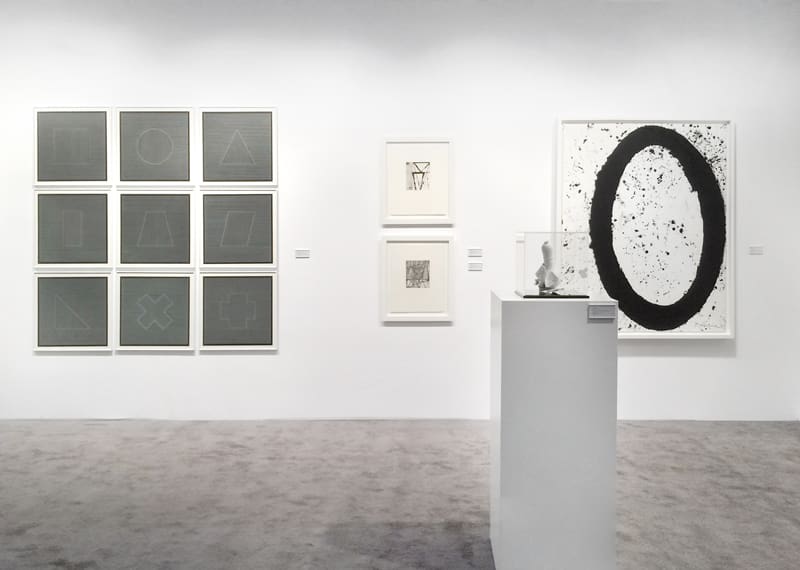
Exhibition View From left to right: Sol LeWitt, Brice Marden, Kiki Smith (on pedestal) and Richard Serra
Mette Aamodt: Hi Andrew. Thanks so much for talking to me today. Just to give some context, your gallery focuses on Minimalist Conceptual Art with a Humanist approach. Can you explain what that is?
Andrew Witkin: Minimalism was an art movement in the mid ‘60s. Donald Judd being a main practitioner, even if none of the people who were “members of it” actually wanted to be minimalists artists. It was about getting away from abstract expressionism. At the same time, also getting maybe away from pop. Pop being about the exterior world and direct pop culture references. Minimalism very simply was about the simple, straight forward objects and reducing your vocabulary that you’re using. The other word, Reductivism, is more of a general category that maybe not everyone uses but we think is probably more appropriate umbrella word for quiet work that is focused on just a few elements as opposed to big bombastic situations.

Josef Albers High Up, 1948, Woodcut
Then Conceptualism and conceptually-based art is sort of if you want to talk in a straight line, comes out of minimalism. It’s a lot about the concept of the work, not necessarily just the execution. With a lot of conceptual art, you don’t have the artist making the work; you have the idea being as important as the final product. You have a lot more information with the work beyond just looking at it.
The Humanist aspect is that it has to touch you. Even if it’s simplified. A lot of people will say, “Oh, that work is cold.” It might initially seem that way, but it has something in it. It talks about the human condition. It resonates somewhere in a deeper way than just superficial ideas.
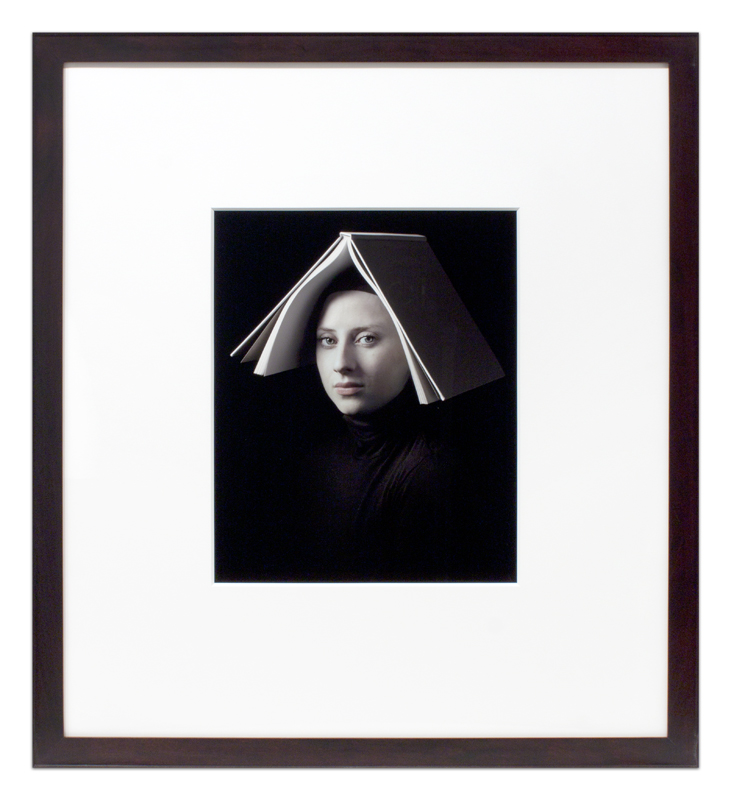
Hendrik Kerstens Book, 2012, C-Print
Mette Aamodt: Well you’re an artist yourself, right?
Andrew Witkin: Yes. I probably wouldn’t use that word, but that’s sort of the vocabulary or world that my own stuff that I make travels in.
Mette Aamodt: What do you make?
Andrew Witkin: Installations and sort of performative stuff. It’s very hard to talk about one’s own work. I especially love talking about other people’s work and being a guide or interpreter. I will say that this is a very great moment for me. The MFA here [in Boston] acquired 4 different works of mine recently, which is phenomenal. One of the pieces they acquired was a sound-based work. It’s the first sound-based work in their collection. Which is really moving to me because I actually come to the visual art world through … It sounds funny, but through sound. Not necessarily straight music, but in terms of sound is art. Sound is performance, and sort of more of experimental music like John Cage and Morton Feldman, and people like that.
Mette Aamodt: Do you have any advice for new collectors or collectors in general?
Andrew Witkin: Let’s see. New collectors: don’t collect yet. How about that as a first phrase?
The most important thing is to look and to wait and to spend time thinking, looking, feeling. People who say, “I want to collect,” and then come in and buy something immediately sometimes have buyer’s remorse. It’s probably not buyer’s remorse, but they’ll outgrow it quicker than if you spend time with it.
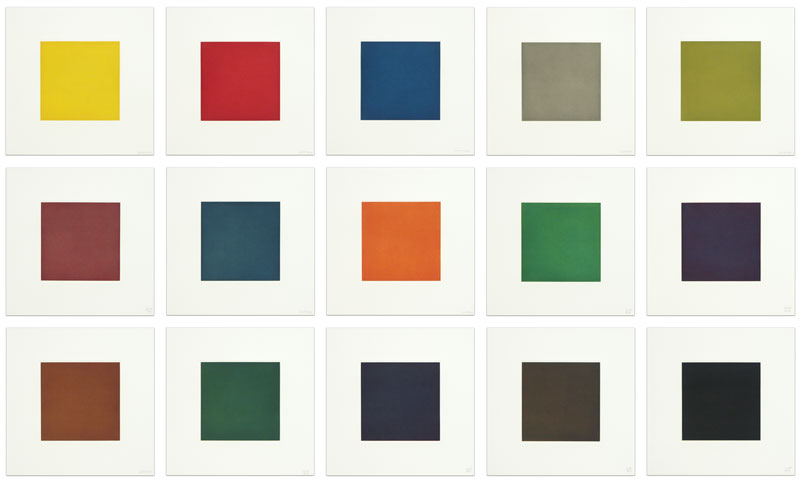
International Fine Print Dealers Association (IFPDA) Art Fair, New York 2015, Sol LeWitt, All One, Two, Three, and Four-Part Combinations of Gray, Yellow, Red and Blue, 1991, Set of fifteen etchings with aquatint
We do something which is what we call “on approval.” Say you came in and you had never bought anything before and you were like, “Listen. I’d like to look at some things. Let’s talk about some art.” We only have maybe 20, 30 things up in the gallery, but we have about 1,200 on the site. We’re happy to bring it all out to show you. A good majority of it is on our website. It’s easy to sort of look, but of course jpegs are very poor representations. No matter how good our photographer is, it’s not the actual art. But say you like something. We’ll say, “Well, why don’t you take it home for a week?” That’s not a sales ploy, because it can be totally seen as a sales ploy.
It’s really just to find out… Do you like it? How does it feel to wake up in the morning and look at it and think about it? When you come home at night and it’s still there, is that okay? What do you feel? What do you think? Was it an experience you liked but you’re done? Or is it something that grows on you? For me as a collector, I like things that grow on me. I like things that I learn from and things that I appreciate the whole time through.
Patience is probably my best advice… More than don’t collect … Patience.
There are plenty of opportunities. Don’t get caught up in the hype. I mean, visual art and design and architecture are becoming much more central in American culture.
It’s definitely becoming more central, but at the same time, if you look at the business section versus the arts section and you tally how many articles about the art world that are in the business section versus the art section, it’s a little depressing to me because there’s a lot of talk about art as investment.
Mette Aamodt: That was a follow-up question I was going to ask. What do you think? There are certainly people out there that are looking for ways to invest …
Andrew Witkin: Right, because they’re reading about it. They’re looking and they’re seeing the dollar signs just increase with contemporary art. The contemporary art that you see at auction, which is what they’re really talking about most of the time, is quite speculative. Just like you wouldn’t go into the stock market without knowledge and do speculative investing, I wouldn’t recommend it.
Mette Aamodt: Good analogy.
Andrew Witkin: It doesn’t seem very smart. You have very savvy people with a lot of knowledge who are manipulating the market, too. You have people who have a very good sense of how to promote and how to get press involved and how to get the right names. Buzz you can build. Increased buzz when you have a market that’s really burgeoning is something that people listen to. But is buzz something that you listen to when you’re investing? I don’t necessarily know the answer, but I wouldn’t. There are a lot of auctions happening right now and you will have work that is made in 2015, which means that an artist made the work, a gallery sold it to someone, and that person is already reselling it. That’s what’s called secondary market.
Secondary market at auction for something that is not even 9 months old. What does that tell you about the person who initially bought it? No real commitment to it. If something is brand new and they’re already throwing it on the market, that’s just flipping. Things move up and down very quickly. The hottest artists from last year … Already not hot. Long term advice: slow and low. That seems to be the way to do it, but even then there’s no guarantee.
The truth is if you can buy a Jackson Pollock, it’s probably going to go up in value. The more that you can invest, the more chance of success and the more chance of failure you have.
All of that to say: don’t really buy art to invest. Think of it as more of a cultural enrichment. When people buy a car, it goes down in value the moment you drive it off the lot. If you think about it that way, there’s such a bonus to art because it just has such intellectual, psychological, emotional aspects to it that you don’t get from buying other things. I think that’s much more important. That’s one take among many. I’m sure there’s plenty of salesmen who will say, “Oh no. It’s a great investment.” We get asked that all the time. When you spend money, you want to know what you’re getting. There’s two aspects of that: there’s the “art,” which are the things I was just talking about, the intellectual, the emotional, the psychological … All that you get from the work and that you see in the work and you can think about and feel and all of that. Then you have the other aspect which is that you have a physical object for the most part.
There’s work in this exhibition in here by Robert Mangold and Robert Ryman and Brice Marden … These are all names that 99% of the world does not know, but within the art world they’re very famous.
One’s $3,500, $7,500, and $15,000 for those 3 pieces. That’s where their markets really are. They have a resale market. You say, “I’m interested in buying that.” I say, “Okay.” “Well, but what am I doing with this money? Am I just supporting a young artist? Am I throwing the money away in the sense that there’s no way I could get anything back ever? Is this money that is perhaps somewhat safer than buying a young artist or whatever?” We can sort of differentiate that. Not 100%.
We can never guarantee anything. We’d certainly never say, “Oh, this is going to definitely go up,” or, “This is definitely going to hold its value.”
But there are some things that have more history. You can talk more about their history. We try to give people that information as well. You’ll have a lot of galleries that will guarantee things and all of that. But how do you do that? The real goal is honesty and transparency.
We really enjoy that because it lifts the veil off the mystery. If you’re talking about your clients and audience maybe not knowing as much and wanting to learn … Just come and learn. Spend time. Think and be open.
Mette Aamodt: When they talk about the volatility of the contemporary art market, are they really talking about very recent work?
Andrew Witkin: A lot of times very recent work or work that has become very involved with the speculative market. You’ll have an artist that for some reason, either there’s a big museum exhibition or something’s going on, so a lot of people are thinking about the same thing. Of course at an auction, all it takes is 2 people to raise a price.
I want it. You want it. I want it. You want it. It just goes up and up and up.
The more people you have, the more chances of somebody with more money having it as the prices go up. Now if that interest suddenly subsides and you’re down to 1 person, you don’t want to be the last person standing if you bought this work at the highest price and now suddenly everyone’s gone and you’re wanting to sell it.
That happens. We stay away from that.
Mette Aamodt: I think that’s what I’m getting at. I also get the sense that the older and the more established artists are going to be well, their value is much more well -known and consistent and more defined.
Andrew Witkin: More defined. Absolutely.
Mette Aamodt: But a work from this year, is it going to be hot next year?
Andrew Witkin: Right. A great Michelangelo is more valuable than a Jackson Pollock. Maybe not actually, but if you think long term, Jackson Pollock has only been dead 50 years or 60 years.
It’s definitive in the history of Western art that Michelangelo is important. Everyone has agreed. There’s still disagreement about Jackson Pollock.
If there’s still disagreement about Jackson Pollock, what about an artist who’s still alive or an artist who just passed away?
Mette Aamodt: What are some of the most commercially successful artists you represent?
Andrew Witkin: Do you literally mean by “commercially successful” someone who has made the most money? Someone who has had the most museum exhibitions? Someone who is considered in the highest echelon? All those things are different. They also overlap, so you don’t have to answer that question.
Mette Aamodt: Yes. Give me all 3.
Andrew Witkin: We represent the estate of an artist named Sol LeWitt. Sol LeWitt is an artist that Barbara started showing in 1971. He shows around the world. He’s got works in almost every major museum of modern contemporary art. He’s certainly very successful.
Then there’s somebody like Josef Albers who’s passed away, but he ran the Bauhaus, or he was one of the leaders of the Bauhaus. He ran the art department at Black Mountain College and then he ran the art department at Yale. One of most significant art educators of the 20th century and sold a lot of work as well.
Then there’s artists who have had long, long, long successful careers with many museum shows and they’ve sold. Then later in life they’re doing even better. This artist Mel Bochner has had 10 years of “commercial success” unlike anything before, but he’s always been super respected. I mean, there’s more catalogs on his work than you could imagine, and yet there are people now beginning to think like speculating on his work. They’re like, “Oh, yeah. He’s young and hot.” It’s like, “Well, Mel’s in his mid ‘70s and he had his first solo museum shows in the ‘60s.”
Mette Aamodt: Young and hot?
Andrew Witkin: Right, exactly. Then there’s an artist named Liliana Porter who’s originally from Argentina but has been in the States since ‘64, I think. She continually sells around the world. She doesn’t have many U.S. galleries, but she has galleries everywhere else. We sell more of her work outside of the States than in. She’s very successful. She’s also very quietly working. There’s all sorts of different ways to be successful.
Then there are other artists who continually have museum shows, but they don’t sell as much. It’s harder work. It’s harder work for people to live with or to want to spend money on.
I mean, we show an artist named Robert Ryman. He’s the artist everyone makes fun of for making white paintings, but that’s what he makes: white paintings.
They’re exquisite. He had a retrospective at MOMA in the early 90s. He’s about to have another major traveling retrospective. His paintings go for hundreds of thousands to millions of dollars, but it’s a select audience. He’s both very successful, yet very narrow in terms of who buys the work.
Mette Aamodt: Andrew, thank you so much for taking the time to speak with me. This has been so education and will be a valuable resource for me and my subscribers.
